«Hola Milano, qué tal?»The chef’s greeting to the guests
It is the dish we ask everyone to start with, at least once. Five fish sliced at the counter, in front of the people about to eat them. It looks like a small gesture, yet behind it lies an entire day of choices, phone calls and silences.
In Milan it is half past four in the morning and our head of fish is already in the car. We are not going to the city fish market, not today: today he drives straight to the auctions in Chioggia. It is something we do two or three times a week, whenever we want to be certain of the catch. In Chioggia the fish comes up from the holds still wet with seawater, and the auction opens at five o’clock sharp.
What he is looking for is easy to list and hard to find: a young bluefin tuna, a medium-sized amberjack, a wild sea bass of no more than a kilo and a half, a salmon — that one arrives from Norway twice a week, from an ASC-certified supplier who has worked with us for three years — and a fifth fish. The fifth fish is the variable. It might be a shi drum, a dentex, an Atlantic bonito, a rock amberjack. It depends. Whatever the sea brought in last night is what we will eat tonight.
By eight, when he is back on Via Mazzini, the kitchen counters have already been scrubbed, the blades sharpened, the ice crushed. We unload. We check. We touch. Good fish has clear eyes, red gills, firm flesh that resists the thumb and then gives way. We check the temperature and throw away anything that fails the first inspection. No discussion.
The cut is a choice.
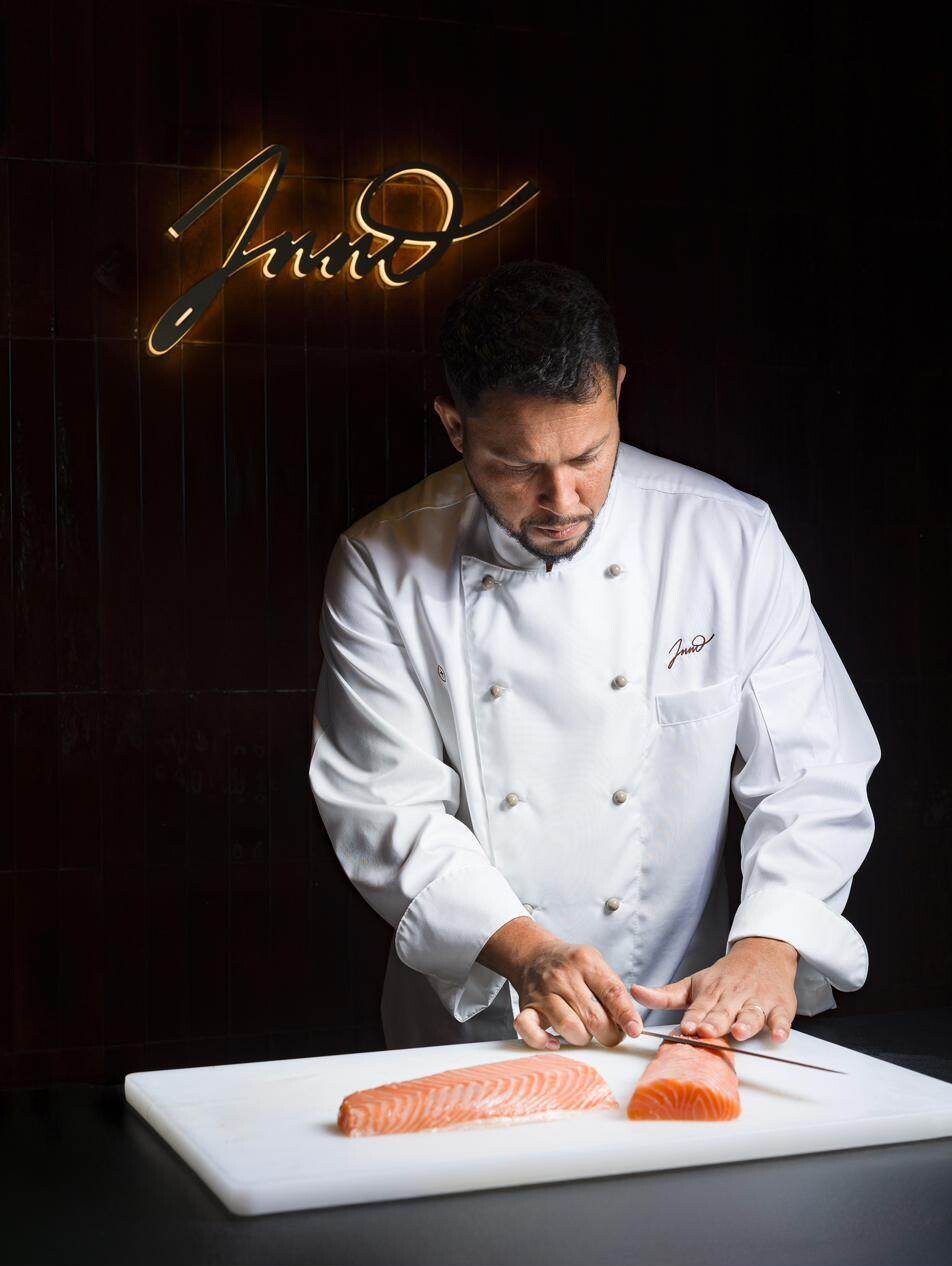
For sashimi, fresh fish is not enough. It also has to be rested for just the right time. Bluefin tuna, contrary to what many people think, is not served straight from the sea: it needs thirty or forty minutes of rest for the fibres to relax. Sea bass, on the other hand, we prepare straight away, while the flesh is still firm. Salmon goes back into the fridge for an hour before cutting. Every fish keeps its own clock.
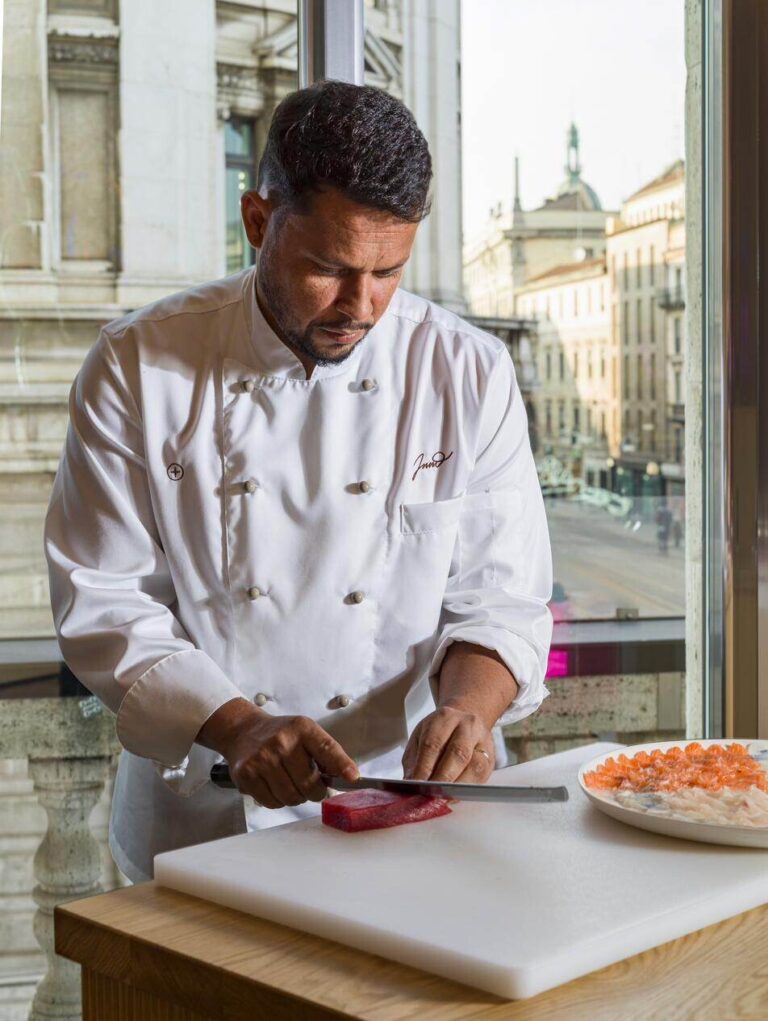
The knife we use is a Japanese yanagiba, hand-forged by a craftsman in Sakai. A long, single-bevel blade, sharpened on one side only. You cut in one continuous motion, from the heel to the tip, never sawing. One slice, one movement. The cut surface must be a mirror: if it is dull, the pressure was wrong. You start again.
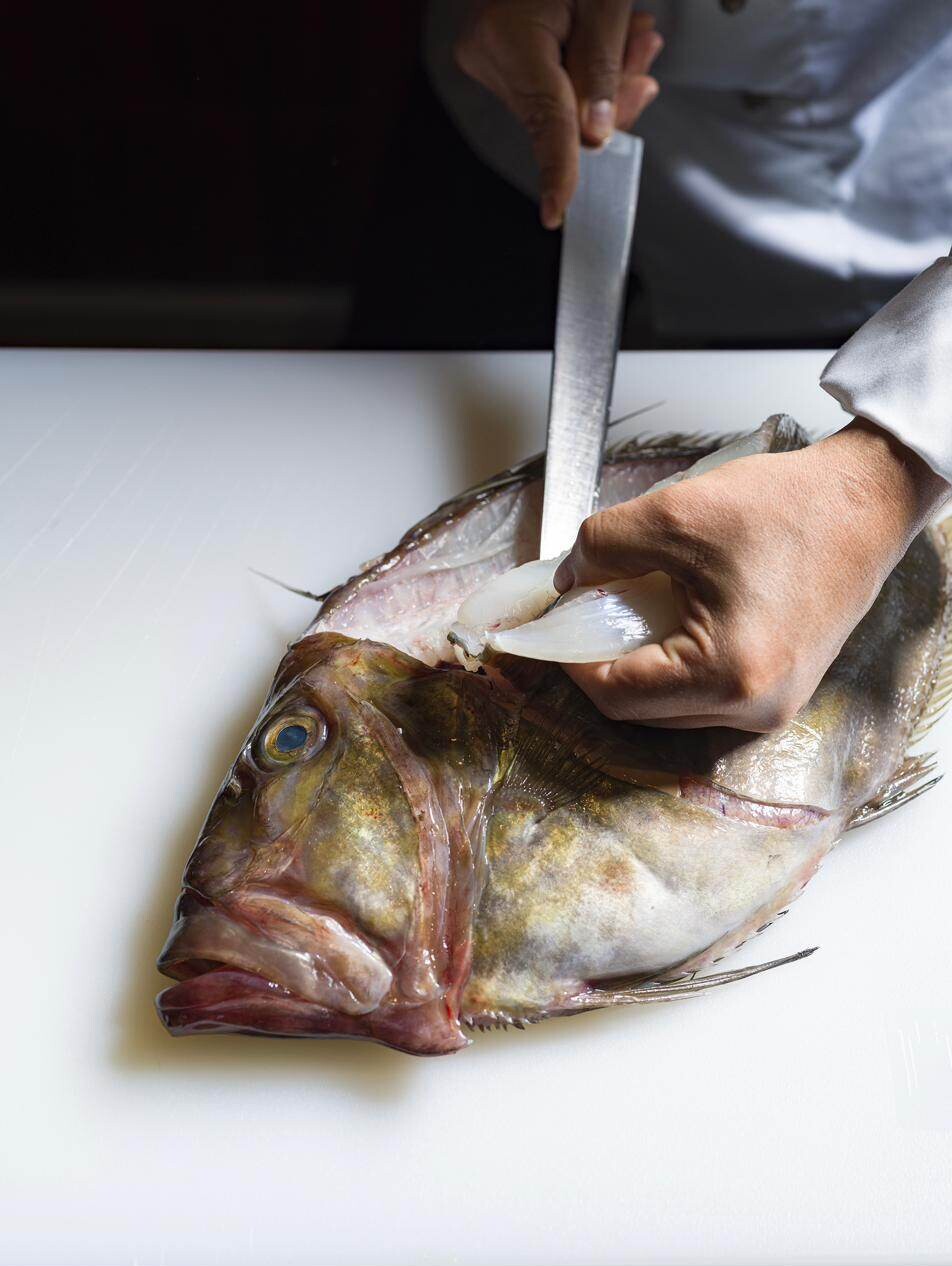
At the counter we work in silence. Not for show: silence is a working condition. Cutting in full view, with a guest a metre away from you, demands a concentration that chatter breaks. We learnt that in Japan years ago, in a small restaurant in Tsukiji where the radio was off and nobody spoke except to say what was essential.
“The cut is a decree. Once it is made, there is no going back. Only forward.”
Five fish, five silences.
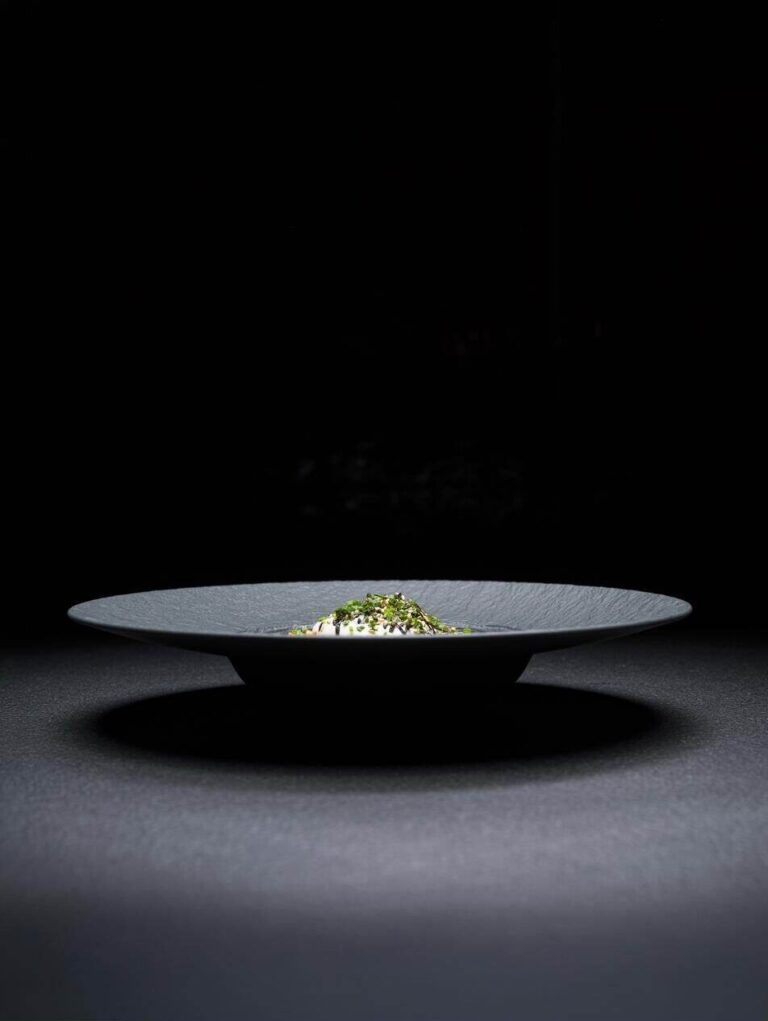
When the dish reaches the table, it looks simple. Five fans of fish on a white plate, no sauces, no needless garnish. A little freshly grated ginger, a small bowl of reduced soy on the side, two or three shiso leaves. What the guest sees is the result. What the guest does not see is the decision to take away, take away, take away — until only what matters is left on the plate.
Each fish has its precise place. The bluefin tuna at twelve o’clock, because it is the darkest and sets the tone of the plate. The salmon to the left of the tuna, because red and orange speak well to each other. The sea bass opposite the tuna, at the bottom, because its translucence needs something to contrast with. The amberjack on the right, with its rosy flesh. The fifth fish, wherever it finds its place.
This is not culinary feng shui. It is function: every fish has its own flavour, texture and ideal temperature. The order in which a guest picks them up changes the experience. Start with the salmon, too rich, and it saturates the palate for what follows. Start with the sea bass, too delicate, and it gets lost in the amberjack that comes next. The plate is designed to be eaten anticlockwise: sea bass, amberjack, salmon, tuna, fifth fish. But nobody says so out loud. We let each guest find their own order.
The dish that teaches.
The INNO sashimi is the dish we use to explain what we do. We suggest it to open the meal, almost always, and guests who have never ordered it often ask us what it contains. We say little. We say: five fish, chosen this morning, cut to order. Try it. Then we’ll talk.
It is a dish that divides opinion. Some guests come back every two weeks just for it, and tell us so. Some would never have ordered it on their own and are surprised. Some go home and try to recreate it, then come back to tell us it doesn’t turn out the same. It doesn’t turn out the same because the fish is not the same, but also because the one thing you cannot buy is missing: the hand of the person cutting. That takes ten years at the counter to build.
One evening a few months ago, a lady ate her sashimi without saying a word. When the waiter came to clear the table, all she said was: thank you. It was exactly what I needed tonight. We need say nothing more. It is for that thank-you, right there, that we open the restaurant every day.
When to try it.
The INNO sashimi is always on the menu. But its selection changes every day with the catch. If you want a particularly good day, we suggest:
- Tuesday to Thursday, when the auctions are in full swing and we have more choice of sizes.
- At lunch, if you prefer daylight and a quieter dining room. The light from the window on Via Mazzini brings out the colours of the fish.
- At the counter, if you want to watch it being sliced. The central counter seats can be booked — there are only four, so it is best to call a few days ahead.
The rest is a matter of curiosity. And of patience: five fish take the time of five silences. If you are in a hurry, order something else. If you have the whole evening ahead of you, take a seat at the counter.